

The entire marketing industry runs on a comforting lie: that there is a right way to do this, a set of proven best practices, and if you follow them carefully enough, you will get results.
So companies follow them. They build the documented content strategy. They run the multi touch nurture sequences. They A/B test the subject lines. They optimize the landing pages. They post on the recommended days at the recommended times. They do everything the guides, the gurus, and the LinkedIn carousels tell them to do.
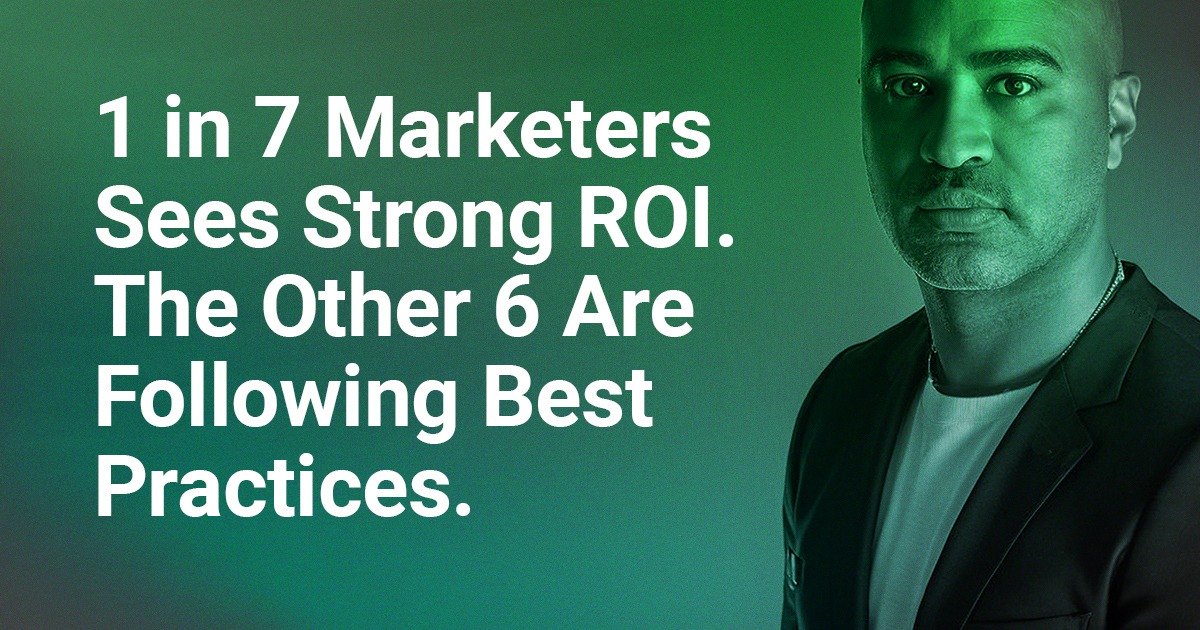
And then the results come in. After years of best practices, tools, and resources, only 1 in 7 marketers reports strong ROI. One in seven. That means six out of every seven marketers are following the same widely recommended playbook and getting mediocre to poor returns for their effort.
Here is the part that should stop you cold. It is not that the six losers ignored best practices and the one winner followed them. It is the opposite. Everyone is following them. The winners and the losers are running the identical playbook. So the playbook cannot be what separates them, which means the thing the entire industry sells as the path to results is not the path to anything except being exactly like everyone else.
The Phenomenon Nobody Warned You About
The Belkins 2026 channel study put real numbers behind something most marketers feel but cannot name. They found that the 85% majority who fail to achieve strong results uses the same channels as the 15% minority who succeed. Email at 87% adoption. Content at 86%. Paid at 82%. The winners and the losers are not using different tactics. They are using identical ones.
Sit with that for a second, because it dismantles the central assumption of how most companies approach marketing. The assumption is that success comes from knowing the right things to do. Find the best practices, apply them correctly, and the results follow. But if the companies getting strong ROI and the companies getting weak ROI are running the same channels, the same tactics, and the same playbook, then knowing the right things to do is clearly not what produces success. The knowledge is evenly distributed. The results are not.
The study’s own conclusion is blunt: the problem isn’t knowledge or tools. It lies in execution. The 85% non excellence rate is not a knowledge gap. Everyone has the knowledge. It is freely available, endlessly repeated, and baked into every tool. The gap is in how the work actually gets done, and best practices say almost nothing about that, because a best practice describes what to do, never how well it gets done in your specific situation by your specific team against your specific competitors.
This is the trap. Best practices feel like the answer because they are concrete, validated, and safe. But they are a description of what is already common, which is the one thing that cannot give you an edge.
Why Best Practices Became a Vanity Exercise
There is a logic problem buried inside the phrase “best practice” that almost nobody examines, and once you see it, you cannot unsee it.
A best practice is, by definition, what everyone is already doing. That is what makes it a best practice. It got documented, repeated, taught, and adopted widely enough to earn the name. The moment a tactic becomes a recognized best practice, it is no longer an advantage. It is a baseline. Everyone has it. It is the price of admission to the category, not a way to win the category.
This is the same arc that plays out with product features. Commoditization increases in every market over time. What was novel becomes table stakes. A great smartphone screen was once a differentiator. Now every phone has one, so it differentiates nothing. Toothpaste that whitens teeth was once a selling point. Now buyers expect even generic brands to do it. The novel thing becomes the expected thing, and the expected thing cannot win you anything. It can only lose you something if you do not have it.
Best practices follow the exact same arc, just faster, because marketing tactics spread at the speed of a LinkedIn post. The documented content strategy, the lead nurture sequence, the SEO checklist, the email cadence. These were edges once, when few companies did them. Now everyone does them. They became table stakes. And a company that builds its entire marketing approach around executing table stakes has built a strategy whose ceiling is, by definition, average. You cannot rise above the pack by doing precisely what the pack does.
This is why the 15% ceiling exists and refuses to move. Execution quality matters more than channel choice, and the comfort with “good enough” is exactly what keeps 85% of marketing stuck. The majority is comfortable running the same playbook as everyone else and calling it strategy. Following best practices feels productive and responsible. It is also the most reliable way to guarantee you finish in the middle of the field.
The Execution Gap Is Where the Real Game Is Played
If the playbook is the same for everyone, the entire competition shifts to execution. And the data on execution is even more revealing than the data on ROI.
The most mature marketing teams execute with 92% confidence versus 57% for everyone else, and that gap comes from aligning strategy, processes, and measurement rather than from knowing different tactics. Harvard Business Review reports that 67% of well formulated strategies fail due to poor execution. Read that carefully. The strategies were well formulated. The thinking was sound. The plan was right. And two thirds of them still failed, not because the strategy was wrong, but because of the gap between the slide deck and Monday morning.
This is the part best practices cannot touch. A best practice tells you to run a multi touch nurture sequence. It does not tell you whether your sequence actually advances the buyer or just fills their inbox. A best practice tells you to create valuable content. It does not tell you whether your content is genuinely differentiated or just another competent post that sounds like everyone else’s. A best practice tells you to optimize your landing page. It does not tell you whether your page makes a stranger believe in you or just checks the boxes a template told it to check.
The difference between the 15% and the 85% is not in the what. It is in the how. How well the message is positioned. How specific the proof is. How sharp the point of view is. How tightly the channels connect. How accurately the measurement reflects reality. None of that comes from a best practices guide, because best practices are generic by nature and execution excellence is specific by nature. The guide is written for everyone, which means it accounts for no one’s actual situation.
Most strategies fail not because they are bad, but because they never get executed well. The companies that win are not the ones with secret tactics. They are the ones who take the same common tactics everyone has and execute them at a level the competition cannot match. That is the entire difference, and it is invisible if you believe the playbook is the point.
The Differentiation Problem Hiding Inside the Best Practices Problem
Here is what makes this so insidious. Best practices do not just fail to create an advantage. They actively erode the one thing that could.
When every company in a category follows the same best practices, every company in that category starts to look the same. The same content structure. The same email cadence. The same landing page layout. The same value proposition language. The same posting schedule. Best practices are a force for homogenization. They pull every company toward the same center, and the center is where differentiation goes to die.
This connects directly to a problem I have written about before. In The Startup Website Problem Nobody Talks About, the core issue was that every startup website looks identical because everyone follows the same template, and identical does not convert. That is best practices in action. The template is the best practice. Following it produces a site that blends into a sea of sites that all followed the same best practice. Sameness is the predictable output of a category where everyone optimizes toward the same documented standard.
Your defense against this is the thing best practices cannot give you: a genuine point of view, a sharp position, and proof that is specific to you. A strong brand is the one asset competitors cannot copy, and it is built on exactly the things no best practices guide contains. Best practices are copyable by definition, which is why following them cannot differentiate you. The things that differentiate you are, by definition, not yet best practices, because if everyone were doing them, they would not differentiate anything.
This is the cruel math of the playbook. The more faithfully you follow it, the more you look like everyone else who follows it, and the harder it becomes for a buyer to understand why they should choose you over the five competitors running the identical plays. If you cannot articulate what makes you different, and best practices are explicitly designed to make you the same, then you have a positioning problem that no amount of best practice execution will solve.
Why This Is Going to Get Worse Before Companies Wake Up
The best practices industry is not slowing down. It is accelerating, and AI is pouring fuel on it.
AI tools are trained on the existing body of marketing knowledge, which means they are trained on best practices. Ask an AI to write your content strategy, your email sequence, or your landing page copy, and it will give you a competent, best practices compliant version of exactly what every other company asking the same question will get. The tools are homogenization engines. They take the average of everything that has been done and hand it back to everyone, which drives the entire category even harder toward the same center.
So the next few years will produce more companies executing more best practices more efficiently than ever before, and the 15% ceiling will not move, because efficiency at producing average output does not produce above average results. It just produces average output faster. The companies relying on AI to scale their best practices compliant marketing are scaling the exact thing that guarantees they finish in the 85%.
Meanwhile, the gap will widen for the companies that understood the real game. While the majority uses AI to produce more competent, indistinguishable, best practices marketing, the minority uses the time AI frees up to invest in the things AI cannot produce: a sharper point of view, more specific proof, tighter positioning, and execution quality that no tool can generate. The playbook becomes more commoditized every quarter. The execution gap becomes more valuable every quarter. Most companies are racing in the wrong direction.
What to Do Instead
If best practices guarantee average, the work shifts from following the playbook to executing better than the people running the same playbook. Here is where to focus.
Start by treating best practices as the floor, not the ceiling. Yes, run the email program. Yes, build the content. Yes, optimize the pages. You need table stakes to compete at all. But understand clearly that doing these things correctly only gets you to the starting line with everyone else. It does not win the race. The moment you find yourself proud of being “best practices compliant,” recognize that you have just described being average, and average is not a strategy.
Then find your point of view, because that is the thing the playbook cannot give you. What does your company believe that your competitors do not? What position can you take that others will not? What can you say that sounds like you and nobody else? This is the work that differentiates, and it is hard precisely because there is no guide for it. If there were a guide, everyone would follow it, and it would stop differentiating. The absence of a best practice is what makes a point of view valuable.
Invest in execution quality over tactical breadth. The data is clear that concentrating effort on 3 to 5 channels with excellence beats executing 10 to 12 channels adequately. Most companies spread themselves across every channel a best practices guide recommends and execute all of them at a mediocre level. The winners do fewer things at a level the competition cannot match. Pick the channels that matter for your specific buyer and execute them so well that the gap is obvious. Depth beats breadth, and execution beats coverage.
Get specific where best practices are generic. A best practice says “use social proof.” Execution excellence says “show this exact result for this exact type of customer in language that proves you understand their world.” A best practice says “personalize your outreach.” Execution excellence says “demonstrate that you did real research on this specific person before you wrote to them.” The gap between the generic instruction and the specific execution is the entire ballgame, and it is where the 15% live.
And measure what actually predicts results, not what the playbook tells you to track. Execution struggles come from operations, not ideas: misalignment, vague strategies, and leadership disconnects. Align your strategy, processes, and measurement so the work is coherent from end to end. This is the unglamorous operational discipline that separates the mature teams from everyone else, and it connects directly to the broader measurement problem I covered in The KPI Mirage. Tracking the metrics the playbook tells you to track is how you end up with a green dashboard and flat pipeline.
The Real Lesson
Best practices were never going to make you exceptional. They were never designed to. A best practice is a description of what is already common, and common is the opposite of an advantage. The entire industry sells best practices as the path to results, but the data shows that the people following them and the people failing are the same people, which means the playbook is not the path to anything except the middle of the field.
The companies that win do not have a better playbook. They run the same plays as everyone else and execute them at a level the competition cannot reach, on top of a point of view the competition does not have. That is the whole secret, and it is unsatisfying precisely because it is not a tactic you can copy from a guide. It is the work that has no guide, which is exactly why it differentiates.
You are not stuck in the 85% because you failed to find the right best practices. You are stuck in the 85% because you found them, followed them, and discovered what they were always going to deliver: a competent, responsible, indistinguishable version of exactly what everyone else is doing. The way out is not a better playbook. It is the willingness to execute better and say something different, in a category where everyone else is busy doing the same proven things and wondering why it is not working.
Stop following the playbook like it is the point. The playbook is the floor. The game is everything you do above it.
For more on building marketing that wins on execution and point of view instead of best practices, visit the Transmyt blog.
About the Author: Jeremy Mays

Keep Reading
Want more? Here are some other blog posts you might be interested in.
Two research firms measured marketing leadership this year and published findings that cannot both be good news. In January, Spencer Stuart ...

Every technology that ever paid for itself removed something. The spreadsheet removed the ledger and the clerk who reconciled it by ...
Stock photography has a specific look. Two people in a bright office, mid laugh, pointing at a laptop nobody is using. ...
For founders and growing companies
Get all the tips, stories and resources you didn’t know you needed – straight to your email!