

Every line in your budget has survived an argument. The $300 seat license got questioned in a comment thread. The $40,000 renewal got three meetings and a procurement review. The offsite got a spreadsheet with two scenarios. Somebody, somewhere, defended every dollar your company plans to spend this year.
Except the biggest one. The biggest one has never been in the room.
Part of the reason is that it appears on no budget. The bigger reason is that it wears the costume of a virtue. Collaboration is on the values wall, in the job descriptions, in every performance review. Question a $40,000 renewal and you look responsible. Question a recurring meeting and you look like someone who does not want to be a teammate. A cost that gets classified as a virtue never gets audited, and this one has been compounding behind that immunity for a decade.
Then somebody priced it. The Collaboration Tax report from Paciva, models the cost at about $13,500 per employee per year, built from findings like 275 interruptions landing on the average knowledge worker every day, five working weeks a year lost to switching between tools, and a cost table that runs from $75,000 a year at ten employees to $37.8 million at five thousand. If $13,500 sounds impossible, good. Impossible numbers deserve their arithmetic shown, so here is the short version of it.
The work about work
Start with where the day goes. Asana’s Anatomy of Work research puts 60% of the average knowledge worker’s day into what it calls work about work. Communicating about tasks, searching for information, switching between apps, chasing status. Not the job anyone was hired to do. The coordination wrapped around the job.
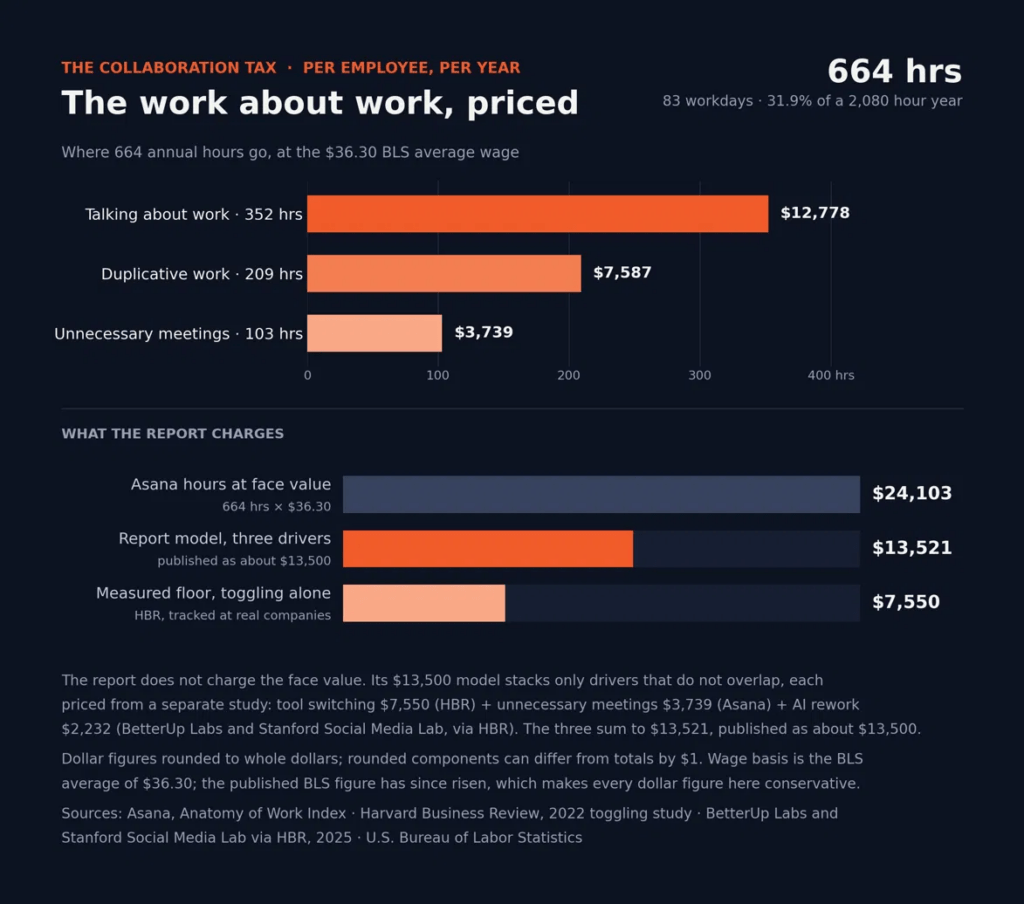
Per worker, per year, that breaks down to 103 hours in unnecessary meetings, 209 hours on duplicative work, and 352 hours talking about work. None of that is laziness and none of it is spam. It is the connective tissue of working through other people, and it consumes the majority of the time you are paying for.
The report names that sum the Collaboration Tax. The price a team pays, in time, money, and focus, for the fact that work has to pass through people. Everyone pays it. Almost nobody measures it, and the reason nobody measures it is that no single system ever presents the bill.
The number, built in the open
Here is the chain, so you can check every link.
The floor is measured, not modeled. A Harvard Business Review study tracked 137 workers across three Fortune 500 companies and found about 1,200 application switches a day, costing just under four hours a week in reorientation time. Four hours a week across a working year, priced at the Bureau of Labor Statistics average wage of $36.30 an hour, comes to $7,550 per employee per year. That is five working weeks, spent moving between places instead of working in any of them, and that is the floor before a single meeting gets counted.
Add the meetings. Asana’s 103 hours of unnecessary meetings adds about $3,740 at the same wage.
Add the newest driver. BetterUp Labs and Stanford Social Media Lab published research in Harvard Business Review on workslop, AI generated content that looks finished and is not. Forty one percent of workers received it in the past month, each instance takes nearly two hours to untangle, and the cost lands around $186 per worker per month. Call it $2,230 a year.
None of those three buckets overlap. Stack them and the modeled total reaches about $13,500 per employee per year. At 250 people, that is $3.4 million, which is not overhead. That is a department, working full time on nothing.
Where the rest of the day goes
The dollar chain understates the texture of it, so here is the texture.
Microsoft’s 2025 Work Trend Index counted 275 interruptions a day across meetings, email, and chat, about one every two minutes during core hours. Honest note the headlines skip: that figure draws on the heaviest communicators, not the median desk, so treat it as the loud end of a real trend. The recovery cost is what makes it expensive either way. Gloria Mark’s research at UC Irvine puts the return to full focus after a significant interruption at about 23 minutes, which means a two minute ping is never two minutes.
Then there is the queue math, the driver nobody sees because it hides inside elapsed time. A task that needs three people is not three people’s time added together. It is three queues, and the work sits idle in each one while everyone involved stays busy. The draft waits on design. Design waits on a logo file. Legal flags a claim, which starts a thread, which becomes a meeting rescheduled twice across three time zones. Two days of effort turns into eleven days of calendar, and the nine day difference was not work. It was waiting, sorting, and chasing. The shape of the meetings makes it worse every year: 30% of meetings now span multiple time zones, and meetings with 65 or more attendees are the fastest growing category. Getting a room aligned has become the job itself.
Then the day overflows. When 60% of the hours belong to coordination, the actual work has nowhere to live except the edges. Microsoft’s same research found 40% of workers reviewing email before 6 am, meetings after 8 pm up 16% year over year, and about 29% back in the inbox by 10 at night. We gave that pattern a hustle name. It is not hustle. It is displacement, and run long enough it stops costing time and starts costing people.
Nobody in your stack is paid to fix this
Here is the part that explains why the tax survives every productivity initiative you have ever run.
Every tool in the coordination stack earns more when you coordinate more. Meeting platforms earn when you meet. Chat tools earn when you message. Most AI vendors earn when you generate. The entire commercial ecosystem around your team is compensated on the volume of the exact behavior the team is drowning in, and nobody in that equation gets paid when your Tuesday gets quieter.
And before the blame lands on the calendar, or the tools, or the boss, one honest admission belongs in this piece. I sent interruptions today. So did you. Every person drowning in the receiving side of this tax is also a sender in somebody else’s statistic. That is what makes it a tax and not an attack. Nobody is doing it to you. Everybody is doing it to everybody, two minutes at a time, and every individual message is reasonable.
Which is why the fix is not a wellness webinar or a focus hack. You cannot self help your way out of a structural cost. You can only measure it, cut it, and take the hours back.
AI is the biggest lever, in either direction
One more finding, because it decides where this goes next.
MIT research in 2025 found that about 95% of organizations saw no measurable return on generative AI. Read past the headline and the reason is in the deployment pattern. Most AI got pointed at producing more, drafts, memos, decks, messages, which feeds the receiving side of the tax and shows up as workslop. The return sits on the other side, in AI pointed at removing the work. Screening what arrives. Replacing the status meeting with the status. Carrying the handoff so nothing sits in a queue.
Same technology. Opposite direction. Only one of them gives the hours back.
Run your number
The test takes ten seconds and one multiplication.
Your headcount, times $13,500.
Ten people is $135,000 a year. Fifty is over $675,000. Two hundred fifty is $3.4 million. The precision matters less than the scale, because the point is not that your number is exact. The point is that a cost this size exists in your company, has no owner, appears in no review, and has never once been argued about the way the $300 seat license was.
One objection deserves a straight answer before anyone runs it. Yes, the $13,500 is a model, and every model invites argument. So argue with the floor instead. The $7,550 from tool switching alone is measured, tracked across real workers at real companies, priced at the government’s own average wage. Take the most conservative reading available and a 50 person company is still lighting more than $375,000 a year on reorientation time nobody chose. The model can be off by a third in either direction and the conclusion does not move.
If the number made you wince, that wince is the beginning of the fix, because the fix starts with measurement. Put a number on the hours going to busywork. Cut the meetings that could have been decisions and the handoffs that could have been direct. Give the recovered hours back to the work only your people can do.
The whole model, every source, every driver, and the path out are in the report. It is the argument your budget meeting never had, ready for the room.
About the Author: Jeremy Mays

Keep Reading
Want more? Here are some other blog posts you might be interested in.
Most companies buying AI this year are buying a noun. What they need is a verb. Gartner expects the world to ...
AI doom is the best IPO roadshow Wall Street never had to pay for. You have watched it all month, and ...

Try changing a logo in a large company. You may need three meetings, six emails, and a person called Steve who ...
For founders and growing companies
Get all the tips, stories and resources you didn’t know you needed – straight to your email!